Innovative manufacturing is thriving in the Hunter, but the “big picture” topic is the transition to renewable energy. Hunter Manufacturing Awards spoke with some leading players paving the road to net zero.
The words “transition to renewables” roll off the tongue so easily they suggest a smooth and brisk process. But desire always requires a dose of reality and managing the mechanism is no easy task. Fortunately for the region and the nation, Hunter manufacturing businesses are at the forefront and lighting the way.
Leading energy company and HMA sponsor AGL supplies about 4.4 million energy and telecommunications customer services and operates Australia’s largest private electricity generation portfolio within the National Electricity Market.
Seth Pathiyil heads AGL’s Hunter Energy Hub. Mr Pathiyil worked for Macquarie Generation and AGL since the company acquired Bayswater and Liddell power stations in 2014. He says he was fortunate to lead the closure of Liddell.
With the transition of the Liddell and Bayswater plants, AGL will use the Hunter Hub to invest and build the next generation of assets for their customers and the community. The Liddell-Bayswater site is about 10,000 hectares and presents opportunities to bring proponent industries into the precinct and help them decarbonise.
“Despite being the oldest coal-fired power station in the country, we successfully and safely retired Liddell,” Mr Pathiyil says. “It has now become the standard for the closure of thermal power stations in Australia.”
After retiring Liddell, Mr Pathiyil was tasked with taking charge of the Hunter Energy Hub, which forms a significant part of AGL’s broader objective of leading the way in transitioning to a clean-energy future.
“We have a clear transition pathway,” Mr Pathiyil says. “Transition means closure or retirement of an asset. In terms of closing thermal power stations respectfully, we have set a standard with Liddell, and we have announced the closure of Bayswater by 2033 and Loy Yang by 2035.
“The second part of our transition is a clear plan to add up to about 12 gigawatts of renewable energy by the end of 2035. This includes a short-term target of about five gigawatts by 2030. These are ambitious targets, but we are confident they will position AGL as a leader in the Australian clean-energy future.”
The third aspect specifically involves the Hunter Region – repurposing and reusing the existing Liddell and Bayswater power station sites. AGL is exploring a range of innovative technologies and projects and working with several project partners to join the Hunter Energy Hub.
“Technology is going to be a key focus,” Mr Pathiyil says. “Integrating cutting-edge technologies such as battery storage, smart grids, renewable manufacturing, and even solar and battery recycling. Creating a circular economy is a key part of our approach.”
Newcastle-based creative agency Out Of the Square teamed with Beyond Zero Emissions to initiate Energy Evolution, a video series championing the region’s growing band of “power players” in green energy. Energy Evolution displays Newcastle and the Hunter’s nascent evolution from its foundational manufacturing and mining heritage to a diversified greener future. The videos showcase innovations, skills, manufacturing prowess, and views of the future.
Commentators describe AGL as an energy “giant”, but the “local” often informs the “universal” and many smaller pictures can complete the big picture. Smaller businesses in the Hunter and surrounding area are making significant contributions to the transition to renewables.
Janus Electric is an HMA applicant, and general manager Lex Forsyth is keen to assert the progress to renewables is a transition.
“Many people are grandstanding around the transition,” Mr Forsyth says. “But it’s not about that. We must stop talking about two minutes and start talking about two decades. It has to be a fixed government policy that sets a path for the next 20 years – what we want to achieve and how we get there – and then roll it out over the next two decades.”
With the push for electric vehicles on the rise, Mr Forsyth acknowledged the pressure on the trucking industry to reduce its carbon footprint. So, he developed an electric truck with an interchangeable battery.
Headquartered in Berkeley Vale on the Central Coast, Janus boasts it is electrifying the road transport fleet with tomorrow’s technology, today. Its revolutionary exchangeable batteries power electric heavy vehicles and take only four minutes to change at a Janus station. Renewable energy sources power the change stations.
Mr Forsyth says for Australia to transition, it must support its smaller manufacturers and offer long-term loans rather than grants – a hand up rather than a handout.
He believes Australia has the intellectual acumen, and the Hunter presents a real opportunity. There is land available, he says, and we have the supporting infrastructure, spectacular services, and the cost of living in the region is attractive – there is a lifestyle for the people. He points to the quality and quantity of high-tech engineering in the region and other innovative businesses.
“Much of the opportunity to transition is a result of the traditional mining industry,” he says. “All the auxiliary businesses are already operating in the region. It’s almost a one-stop manufacturing shop. But it will take two decades to transition because there is so much that must occur.”
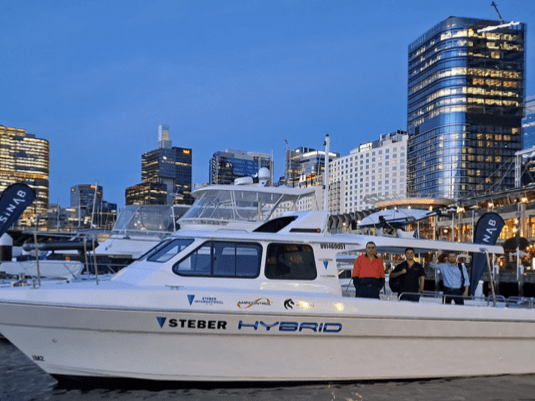
Steber was a successful Sydney business but relocated to Taree 50 years ago. It’s now a regional business making waves worldwide with its hybrid electric boats. It is also an HMA applicant. The Out Of The Square series features Tomago-based Ampcontrol and delves into its collaboration with Steber International.
AGL’s Mr Pathiyil says the key piece for the Hunter precinct, or energy hub, is the circular economy.
It resonates with Steber International general manager Alan Steber, who remembers when he first started researching electric hybrid boats.
“We were in Sydney taking in the view from Darling Harbour,” he says. “The police boats were idling around with outboards and/or diesel, just keeping a presence around the Opera House and Lady Macquarie's chair.
“I thought, surely they could use an electric boat for that. So, we did a proof of concept 22-footer with the University of Newcastle and Ampcontrol as our partners. Ampcontrol does a lot of work for the mining industry and is acutely aware of the transition to renewable energy. It is looking at new forms of energy.”
Steber then upped the ante and set about building a large 43-footer. It now provides these large battery-powered boats to Defence, the police, maritime authorities, charter operators, and marine parks.
“The boat we launched won at the Sanctuary Cove boat show and we were also named the innovator company of the year for the whole of Australia with our electric-hybrid boat,” Mr Steber says.
Steber previously collaborated with Solar Sailor, now known as OCIUS, building the first round of Bluebottles – unmanned surface boats. This progressed to working with Newcastle-based Thales on minesweepers. Then it built a Defence scientific research boat that launches and finds underwater drones.
“The first step to renewables is the circular economy,” Mr Steber says. “We’re now doing refits on our Steber Defence boats back in from the end of the 1990s. We convinced the Department of Defence not to scrap them. The boats aren’t falling apart, they just need a refit program.
“A brand-new boat would cost about $1.8 million. We’ve just delivered two of them with total repower refit, new diesel engines and upgrading electronics, for less than $600,000. We can provide Defence with refits almost equivalent to a brand-new boat for a third of the price. That's a good start. Those boats are not ending up in our tip. We built the first boat, and 28 years later we performed the refit on them. And they will last another 28 years.”
The road to net zero is paved with good intentions. Innovative local companies are doing their best to ensure it’s not a bumpy ride.